









Architecture begins in the gaze, not in the plan. With her “School of Seeing”, Anna Philipp calls for a rethinking of the foundations of design – towards an architecture born of attentiveness, attitude and beauty.
Architecture does not begin with a floor plan or a rendering, but with a gaze. With the way we perceive, interpret, and question the world. In my manifesto of a “School of Seeing”, I argue that the education of architects must once again start from this elementary competence: a cultivated, trained, and loving gaze at space, people, and the world.
School of Seeing – more than perception training
By ‘School of Seeing’ I do not mean a purely technical course in perception, but a fundamental attitude:
- Seeing as an active act of attention – not just “looking at”, but “wanting to understand”.
- Seeing in awareness of what came before us – tradition, building culture, craftsmanship – as a prerequisite for what we newly bring into the world.
We have become accustomed to consuming architecture through images. Social media feeds, renderings, awards – everything produces surfaces. A School of Seeing reverses this logic: before we produce images, we learn to read the world. Proportions, transitions, joints, the traces of time, the dignity of a well aged material.
In my talks I often say that beauty is “like a place you do not want to leave”. That place begins inside those who design – and in what they have learned to see.
Drawing, models, material – spaces of sensing
The classic instruments of foundational teaching – drawing, model, material experiment – are, for me, concrete spaces of this School of Seeing.
- In drawing, the hand learns what the eye has previously overlooked. Every line is a decision: what is essential, what can go?
- In the model, spatial quality becomes physically tangible. One cut, a small shift, a different material thickness – and the space “tips” into a different character.
- In material experiments, the body experiences what surfaces, temperature, and acoustics do to us: how wood gives a sense of shelter, stone conveys stability, fabric creates intimacy.
These experiences are more than “exercises”. They are early forms of what Otto Scharmer’s Theory U calls “sensing”: a deep tuning into a situation before we decide.
Learning from Theory U: seeing as sensing
Theory U describes a process in which we do not only learn from the past, but from the future that is in the process of emerging. Three core attitudes from this approach are especially fruitful for foundational teaching:
- Open Mind – questioning our own assumptions about “good architecture”, challenging references, staying curious.
- Open Heart – looking with empathy at what spaces do to people: to their bodies, their psyche, their ways of living together.
- Open Will – being willing to let go of established design habits and allow ourselves to be called by something genuinely new.
In a School of Seeing, these layers come together in a very concrete way: students do not only observe, they listen – to places, people, atmospheres. They “sense” what a place could become, not just what it currently is.
Presencing – the coming together of presence and perception, as Scharmer calls it – happens when a studio suddenly becomes quiet because everyone feels: “Now something is right. Now this space has found a coherent form.” These moments cannot be forced, but we can create conditions that make them more likely: through time, depth, and seriousness in dealing with the foundations.
Attitude instead of style – learning from the future
Many students begin with a strong world of images. They know exactly which offices they admire, which aesthetics “work”. The danger: they reproduce styles instead of developing their own attitude.
Here, the connection between a School of Seeing and Theory U can be very powerful:
- First: pausing. Not designing immediately, but seeing, listening, noting, drawing.
- Then: letting go – even of the favourite reference, the first image in the mind.
- Finally: allowing something unexpected to emerge – a space, a gesture that is not copied from the past, but arises from the specific situation.
Learning “from the future as it emerges” in architecture means not asking primarily “How has this always been done?”, but “What does this place, this community, this future need from us?” And then, with the trained gaze of a School of Seeing, examining whether our answers truly measure up to that.
Beauty as a guiding star
In my “Manifesto for a Beautiful Future” I argue that beauty is neither a luxury nor a surface category, but a force of orientation in times of upheaval. Truly beautiful spaces are sources of strength. They offer a sense of home, inspire creativity, and carry people through crises.
A School of Seeing is therefore always also a school of beauty:
- It sharpens the ability to distinguish between effect and depth.
- It heightens sensitivity for what endures when trends have faded.
- It invites a gaze of love – at places, people, materials, at what is already there.
If we cultivate this gaze in foundational teaching, a generation of architects will emerge who not only “plan correctly”, but want to create spaces that do good to people in their innermost being.
A plea for taking foundations seriously
Architecture begins with seeing – with a trained, open, loving gaze. In a time in which technology takes many things off our hands, we must not delegate this.
A contemporary approach to foundational teaching
- combines analogue and digital tools,
- cultivates perception, empathy, and responsibility,
- understands design as a process of listening and responding – in the spirit of Theory U’s “learning from the future as it emerges”.
If we transform our studios into true Schools of Seeing, we teach more than technique. We help young people to find their own gaze – and with it their contribution to an architecture that unites beauty, meaning, and future viability.
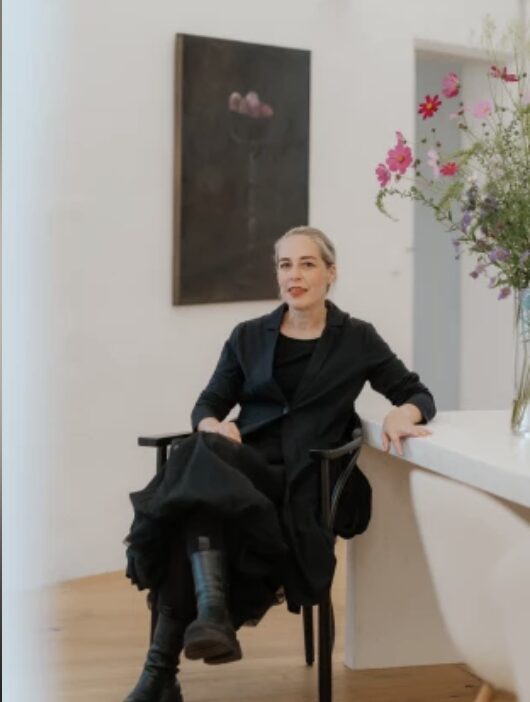
Anna Philipp is an architect and leads the office Philipp Architekten with studios in Germany and Switzerland. In publications, films, and lectures she advocates for a “renaissance of beauty” and for foundational teaching as a School of Seeing in architecture.