









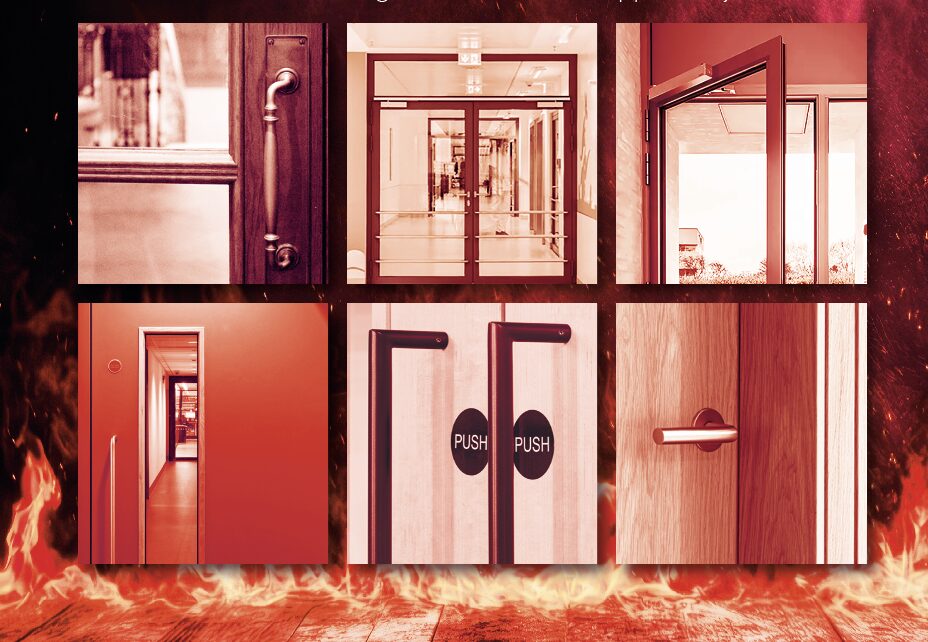
Manufacturers, specifiers, and suppliers are preparing for the most significant change to fire door testing and certification in decades: the transition from BS 476 to EN 1634, Leading voices discuss what it means — and if the change is a burden or an opportunity.
Around the table:
- Rob Mottram,
Technical manager, ARRONE
- Andrew Davies,
Senior technical sales engineer, Halspan
- Jim White,
Technical director, Forza Doors
- Simon Ayers,
Managing director, SDS London
Design impact and the push for performance
The move to EN 1634 will reshape how doors are built and tested, bringing tighter control over heat transfer and insulation. Rob Mottram opened the discussion, noting that for steel door manufacturers, the biggest shift will be in meeting the new EI (integrity and insulation) classification.
“EN 1634 demands quantifiable limits on heat transfer,” he said. “For steel doors that means integrating enhanced insulation within the leaf and frame assemblies, and re-engineering core structures, thermal breaks and intumescent systems to maintain performance under higher temperatures.”
Davies agreed that the EN standard is tougher — but pointed out that Halspan’s early adoption has left them well prepared. “We’ve been testing to EN 1634 since 2000,” he explained. “The more onerous pressure regime — particularly the lower neutral pressure axis – makes testing far more demanding, especially for taller doorsets. That’s driven us to use enhanced seal configurations and to think more carefully about glass selection.”
White added that for timber doors, hardware protection has also come under greater scrutiny. “Enhanced intumescent protection for items like concealed closers at the head of the door is required,” he said. “We see erosion at the top corners and meeting edges accelerate under EN testing. It’s forcing us all to refine designs for durability and fire resistance.”
Balancing testing, EXAPs, and cost
Testing every possible configuration under EN 1634 simply isn’t realistic, so much of the discussion turned to the use of Extended Applications (EXAPs) to broaden certification coverage.
Mottram said ARRONE plans to combine targeted direct testing with strategic use of EXAPs: “Given the modular nature of steel door systems, EXAPs provide a cost-effective route to demonstrate compliance across a wide range of configurations. It’s about optimising investment without compromising regulatory integrity.”
“We can all help by linking to those resources [from trade associations]. There’ll be a lot of misinformation during the transition so consistency is key”
Jim White
Davies described Halspan’s approach as a long-term testing strategy, built on foresight.
“We’ve already tested every configuration for 30 and 60 minute doorsets multiple times, including large double doors with overpanels,” he said. “We’re working on comprehensive EXAPs for our Prima range – some of the most extensive in Europe.”
White, meanwhile, struck a pragmatic note. “EXAPs will be essential, but they’re still fairly restrictive,” he cautioned. “We’ll rely on them where we can, but manufacturers may need to phase out some less common options to manage costs and coverage sensibly.”
Managing the transition
For all three manufacturers, running dual systems – BS-tested and EN-tested – during the overlap years presents logistical and communication challenges.
Davies said Halspan’s long-standing EN testing programme means they’re already ahead of the curve. “Our products haven’t changed – only the certification has,” he said. “Most of our current BS-based field of applications already contain more EN evidence than BS. That gives us a strong foundation to build on up to 2029.”
White agreed that planning ahead is key: “We switched to the EN regime two years ago, so our EN tests already support both systems until the cutoff. It’s about being ready in good time rather than scrambling later.”
Helping the market understand FD vs EI
If there’s one thing everyone agreed on, it’s that market education will be crucial as the industry transitions from FD30/FD60 classifications to EI30/EI60.
Davies said Halspan’s proactive work with specifiers through the Halspan Verified initiative aims to demystify the change. “We’re working with architects and NBS to ensure the right designs, BIM assets and specifications are readily available. We’re also engaging directly with installers and building owners to explain the new requirements in plain terms.”
White added that manufacturers should signpost the wealth of guidance coming from certification bodies and trade associations. “We can all help by linking to those resources,” he said. “There’ll be a lot of misinformation during the transition,
so consistency is key.”
Mottram agreed, stressing that manufacturers should take the lead in educating the market, supported by trade bodies and suppliers. “We have the technical expertise, so it’s on us to make that knowledge accessible – through guides, training, and clear communication.”
Testing bottlenecks and collaboration
With hundreds of products needing revalidation, there’s concern about bottlenecks at test labs. Davies was cautiously optimistic.
“There’s more capacity than ever – several new labs have opened in the past five years,” he noted. “The bigger issue is certification. Approved bodies are struggling to recruit experienced assessors, and that’s creating delays in issuing field of application reports.”
Mottram agreed that collaboration will be vital to avoid backlogs. “We’re booking test slots early and coordinating with hardware partners to share data where possible,” he said. “Joint testing programmes can save time and reduce duplication.”
White, meanwhile, reflected on the delicate balance between collaboration and competition. “Door and hardware manufacturers are becoming more intrinsically linked,” he said. “Shared testing can make sense, but it does mean giving up exclusivity. Still, we’ll need to find new, mutually beneficial ways to work together as we head toward 2029.”
Ayers, representing the architectural ironmongery perspective, echoed that sentiment. “For specifiers, planning and communication will be key,” he said. “We’ll need to factor testing timelines into every project from the outset.”
Opportunities for innovation
Despite the challenges, the panel agreed that EN 1634 also represents a chance
to innovate.
Davies said Halspan sees the shift as an opportunity rather than a burden. “It moves the focus from component compliance to the performance of the complete doorset,” he explained. “That opens doors for multi-disciplinary testing – fire, smoke, acoustics – on the same specimen, which delivers more robust, better-performing products.”
“It’s definitely a headache for specification, but it gives us an opening to work more closely with manufacturers – ultimately producing a better outcome
for clients”
Simon Ayers
White described it as “both a headache and an opportunity.” “The costs are significant and the learning curve is steep,” he said. “But the EN system will bring clarity and consistency across certification bodies – and that’s good for everyone.”
Mottram agreed. “This isn’t just about meeting new requirements – it’s a chance to develop better integrated systems,” he said.
Ayers added that for ironmongers, it’s also a moment to strengthen collaboration. “It’s definitely a headache for specification,” he admitted, “but it gives us an opening to work more closely with door and doorset manufacturers – ultimately producing a better outcome for clients.”
Who leads the learning curve?
On education, there was unanimous agreement that no single group can do it alone.
Davies was clear: “Before we educate the wider industry, we need to educate ourselves. Understand the routes to compliance, live them, and then share that knowledge.”
Ayers suggested that trade bodies should take the lead – with support from manufacturers. “If the GAI and others deliver a consistent message, it’ll carry more weight,” he said.
White agreed that certification bodies and associations are best placed to steer the process, but all parties have a role to play in amplifying it.

As the discussion drew to a close, the participants reflected on what could make future transitions smoother.
Mottram called for a structured, phased transition framework across the industry. “A central roadmap would reduce confusion and duplication,” he said. “It would help everyone plan more effectively for what’s coming next.”
White would have liked to see greater recognition of legacy test evidence. “The ability to utilise BS test data within EN classifications would have saved millions,” he said. “Future standards should find ways to build on past evidence rather than starting from scratch.”
Davies was optimistic that the move to EN would in itself make future change easier. “This transition will bring harmony to doorset certification,” he said. “It should defragment the current system and support a more integrated, multi-performance approach.”
Ayers closed on a practical note. “Clearer planning and communication next time round would make all the difference,” he said. “We simply need enough time – and enough capacity – to do it right.”
As the 2029 deadline approaches, the mood across the table was a blend of realism and optimism. The EN 1634 transition is undoubtedly demanding – technically, financially, and operationally – but it’s also a pivotal moment for raising performance standards and collaboration across the industry.
As Mottram put it: “It’s not just about compliance – it’s about progress.”