









A technology company producing a door hardware product? Nicky Roger meets Alex Nielsen, the inventor behind UAP’s new anti-microbial plating offer

When the pandemic hit in 2020 the architectural hardware sector became – understandably – fixated on anti-microbial finishes and products. There was a lot
of talk about copper, silver ions, and nylon coatings.
Fast forward to 2025 and enter a new player in that mix: Armasmart®. Armasmart® door hardware, uses a smart additive technology that can be applied within an existing metallic plating process to provide in-service protection.
Armasmart® is the brain child of Alex Nielsen, who developed the technology during his PhD at Swansea University in 2016. He was funded by the Royal Mint who were championing R&D at the time and needed a solution to tackle the labour-intensive way of identifying fraudulent pound coins.
The answer was to develop an additive to go into the electroplating solution, so that the identification of dud money could be done automatically. The Mint wanted to go a step further and develop a solution to corrosion and tarnishing which Nielsen also delivered.
The results had Nielsen pondering: in an age of increasing digital payment
the days of coins were arguably numbered. So where else could this technology be applied?
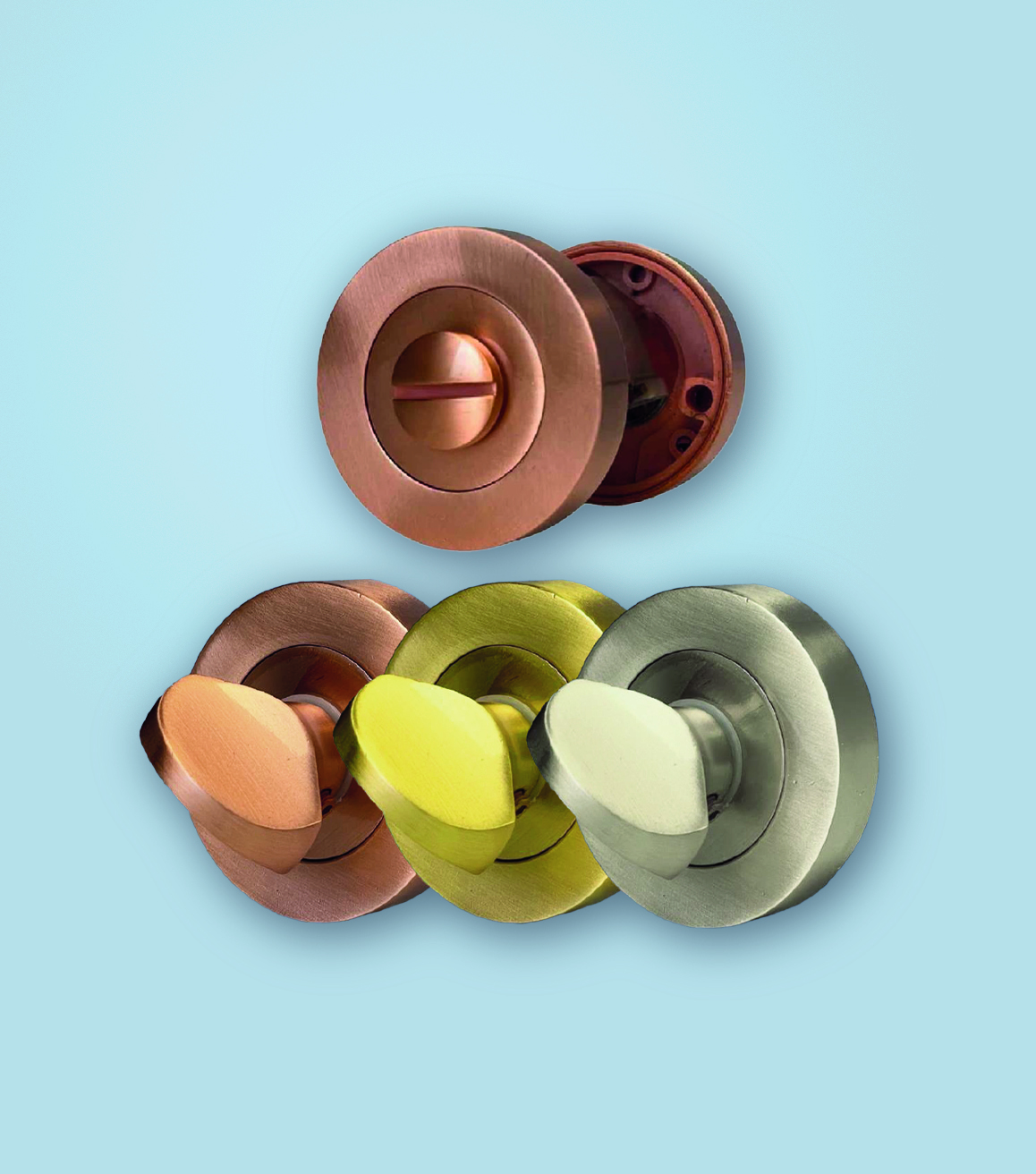
One answer was door hardware. How Nielsen discovered this application was, entirely serendipitous. Professor Dave Penney, one of the academics at Swansea University working with Nielsen, was chatting to his mum’s neighbour over the fence during lockdown. His neighbour was Richard Morris, fire door compliance manager at UAP, who explained how the company would like to bring out an anti-microbial door hardware range in response to the pandemic. Nielsen’s business Armadillo Metal Coatings and UAP became partners and Armasmart® was launched.
Anti-microbial hardware isn’t unique. So what sets Armasmart® apart from other options in the market? Benefits are four-fold, says Nielsen: its efficacy, aesthetics, cost and sustainability.
Firstly, the ceramic nanoparticles that deliver the anti-microbial power kill 99% of not only bacteria but also viruses. Nielsen explains. “A lot of competitor products use silver ion technology. Silver is highly effective, destroying certain strains of bacteria – the same ones that we’ve tested like E coli and MRSA, but it’s not good at all with viruses, such as coronavirus. So they really can only claim anti-bacterial. They can’t claim anti-microbial.”
Armasmart® ’s initial virology testing was carried out at Cardiff University as part of an NHS Wales programme and more recently the team at UAP conduced a four-hour surface test comparing Armarsmart’s germ-fighting ability with copper and stainless steel. Armasmart® door hardware was installed in communal toilet area, a canteen area and a bannister where everyone goes upstairs to the offices. Swabs were taken and the results compared.
Armasmart® and Copper were both shown to be >99% effective at destroying microbes but Armasmart®, unlike Copper, does not tarnish over time. “There’s an aesthetic advantage,” says Nielsen. “After about a year in a normal environment Copper oxidises and it looks perversely, quite grubby, whereas Armarsmart® remains bright and shiny.”
A third claim is its cost. “Silver is expensive,” says Nielsen. “If you take a door handle with the silver ion technology and our technology, this is is noticeably cheaper. Of course specifiers and clients are interested in anti-microbial coatings, but not if they cost two or three times as much as a normal door handle.”
Nielsen also points to sustainability benefits as the anti-microbial action
does not reduce over time; and it reduces clearning regime demands, which
reduces human error as well as water and chemical use.
Licence to kill
Healthcare settings are Armadillo’s target sector. Nielsen is particularly keen to work on the NHS’s £15bn New Hospital Programme. And in those settings he sees opportunities to apply the tech beyond door hardware, such as to surgical beds or equipment. “That’s why we have that identity; an anti-microbial additive company,” says Nielsen. “There are so many things you can do with it that it kind of blurs boundaries. I like to describe it is a technology company.”
Conversations are taking place with other building materials manufacturers. For example for anti-microbial paint which would offer a solution to black mould issues – pertinent following Awaab’s law which came into force in October. The plan is to continue to partner and license the product into different applications. “Armadillo is a technology company with intellectual property that we will licence out and then move on to the next challenge,” explains Nielsen.
Meanwhile door hardware specifiers – particularly those working on healthcare projects – can learn more in a CPD that Armadillo is delivering to GAI members at regional Hubs beginning at the South East in March 2026.